Here it is straight: on a UK track, men clear barriers at 1.067m over 110m, women at 0.84m over 100m, both events use ten hurdles, and the 400m hurdles spread further apart over a full lap at lower heights of 0.914m for men and 0.762m for women. Spacing, height, and run-in change with every event, and they are never improvised. That first barrier sits 13m from the line in the women’s 100m hurdles and 13.72m in the men’s 110m. Get those specs right and the rest is rhythm, which is the part of hurdles on a track that nobody tells you matters most.
Table of Contents
- 1 The Standard Hurdle Events on a Track
- 2 Hurdle Heights by Event, Sex, and Age Group
- 3 Hurdle Spacing and Distances for Each Event
- 4 Full Specs Table: Heights and Spacing at a Glance
- 5 Hurdle Technique: Lead Leg, Trail Leg, and Rhythm
- 6 How Hurdles Fit Your Sprint and Speed Work
- 7 FAQs about hurdles on a track
- 7.1 What are the hurdles on a track called?
- 7.2 How many hurdles are in a 100m hurdles race?
- 7.3 How high are hurdles on a track?
- 7.4 What is the distance between hurdles?
- 7.5 What is the difference between 100m hurdles and 110m hurdles?
- 7.6 Why are hurdle races run in lanes?
- 7.7 How many steps are between hurdles?
- 7.8 What happens if you knock over a hurdle?
- 7.9 Can beginners learn hurdles safely?
- 7.10 Is hurdling more about speed or technique?
Table of Contents
- The Standard Hurdle Events on a Track
- Hurdle Heights by Event, Sex, and Age Group
- Hurdle Spacing and Distances for Each Event
- Full Specs Table: Heights and Spacing at a Glance
- Hurdle Technique: Lead Leg, Trail Leg, and Rhythm
- How Hurdles Fit Your Sprint and Speed Work
- FAQs about hurdles on a track
The Standard Hurdle Events on a Track
Four hurdle events show up on a standard UK track, and they sort cleanly once you know the names. The women’s sprint hurdle is the 100m hurdles. The men’s sprint hurdle is the 110m hurdles. Both sexes contest the 400m hurdles, the long hurdle event run over a full lap. Add the youth and indoor variants (60m hurdles indoors, plus age-group versions with lower barriers) and you have the full set you will meet at a club night or schools meeting. If you searched the term hoping to confirm which event is which, that is your answer before the specs even arrive.
Sprint Hurdles vs Long Hurdles
There are two real families here, and most reference pages blur them. Sprint hurdles, the 100m and 110m, are ten low barriers run flat out, where the whole race is a held rhythm at near top speed. The long hurdle, the 400m, is a different animal: ten barriers spaced across a full lap, set up so fatigue, not raw speed, decides the finish. Same word, two very different races.
Hurdle Heights by Event, Sex, and Age Group
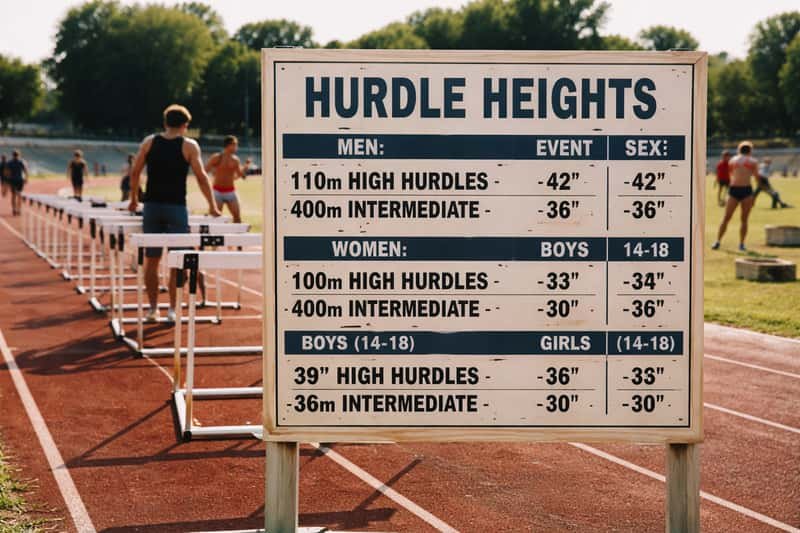
Here are the numbers without preamble. The men’s 110m hurdles stand at 1.067m. The women’s 100m hurdles stand at 0.84m (World Athletics, 2024). For the 400m hurdles, the barriers are set lower than the sprint events: 0.914m for men and 0.762m for women. Those four figures answer the “how high are hurdles on a track” question that most searchers arrive with. Heights then drop for junior, youth, and masters categories, so the barrier you train over depends on who you are, not just which event you entered.
Senior Men’s and Women’s Heights
The senior standards above are fixed by World Athletics and used across UK competition. The 400m heights sit lower than the sprint barriers for a simple reason: you are clearing them tired, late in a lap, with a longer run between each. A taller barrier at 350m in would wreck the rhythm and the safety margin, so the height follows the distance.
Youth and Masters Adjustments
UK Athletics and school athletics lower both height and spacing for younger age groups, then step them up as athletes grow. Masters athletes returning to the event race over lower barriers banded by age. Here are the common sprint-hurdle heights you will meet:
| Category | Typical sprint hurdle height |
|---|---|
| Under-13 (mixed) | 0.686m |
| Under-15 girls | 0.762m |
| Under-15 boys | 0.838m |
| Under-17 women | 0.762m |
| Under-17 men | 0.914m |
| Under-20 / senior women | 0.84m |
| Under-20 / senior men | 1.067m |
| Masters men (50+) | 0.914m |
| Masters women (40+) | 0.762m |
The principle is consistent: the event scales to the athlete, not the athlete to the event. You do not have to clear a senior 1.067m hurdle to call yourself a hurdler.
Hurdle Spacing and Distances for Each Event
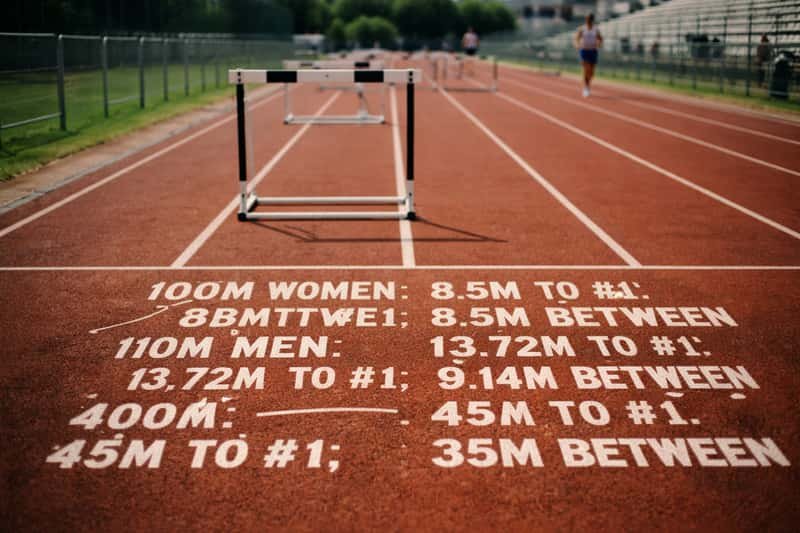
Spacing is where first-time setups go wrong. Every hurdle event has three distances that are never the same: the run to the first hurdle, the even gap between the ten barriers, and the run-in from the last hurdle to the finish. The official measurements live in the governing body’s competition and technical rules, and they exist so the stride pattern stays identical for every athlete in every lane. Get one of the three distances wrong and the rhythm collapses.
100m and 110m Spacing
The women’s 100m hurdles starts 13m to the first barrier, then 8.5m between each of the ten, with a 10.5m run-in to the line. The men’s 110m hurdles runs 13.72m to the first, 9.14m between barriers, and a 14.02m run-in. The men’s gaps are longer because the men’s barriers are higher and the athletes taller, so the three-stride rhythm needs more room.
400m Hurdle Spacing
The 400m hurdles places the first barrier 45m from the start, then 35m between each of the ten, with a 40m run-in to the finish. That long, even spread over a full lap rewards a settled rhythm and disciplined pacing far more than a sprint start. Go out too hard and the back-straight hurdles arrive while your legs are already gone.
Full Specs Table: Heights and Spacing at a Glance
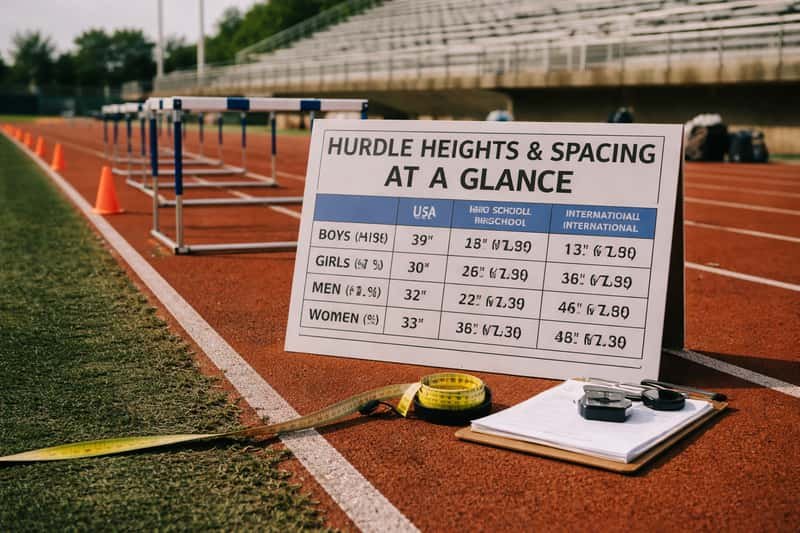
This is the block to screenshot. All four senior events, the numbers you need to set up a lane or check what you cleared.
| Event | Hurdles | Height (senior) | To 1st hurdle | Between hurdles | Run-in |
|---|---|---|---|---|---|
| 100m hurdles (women) | 10 | 0.84m | 13m | 8.5m | 10.5m |
| 110m hurdles (men) | 10 | 1.067m | 13.72m | 9.14m | 14.02m |
| 400m hurdles (women) | 10 | 0.762m | 45m | 35m | 40m |
| 400m hurdles (men) | 10 | 0.914m | 45m | 35m | 40m |
Youth and masters categories use lower heights and tighter spacing banded by age group. Every hurdle race runs in dedicated lanes from gun to line to keep each athlete’s clearance pattern consistent and prevent collisions, and a single false start in competition means disqualification.
Hurdle Technique: Lead Leg, Trail Leg, and Rhythm
Without a coach standing over you, technique sounds mysterious. It is not. Lead leg drives up and through the barrier, knee first, then snaps down fast on the far side. Trail leg folds flat and quick, knee high and out to the side, pulling through to land you ready for the next stride. Posture stays tall and leaning slightly forward, eyes up the lane, not down at the barrier. Technique is what makes hurdling cheap. When your stride pattern is right, you skim each hurdle and keep your speed; when it is wrong, you brake, reach, and burn energy you needed for hurdle ten.
Lead Leg and Trail Leg Mechanics
Do this: drive the lead knee up and straighten the leg over the barrier, then pull it down sharply so your foot lands close behind the hurdle. The trail leg follows flat and high, knee leading, ankle turned out, sweeping through to the front. Two legs, two jobs, no jumping. You clear, you don’t leap.
Stride Pattern Between Hurdles
Sprint hurdles run on a three-stride rhythm between barriers: three steps, clear, three steps, clear, all the way down. That fixed count is the whole game. Losing the pattern costs you more than running slightly slower, because every reach or chop after a missed step compounds down the lane. If you want to see why holding the count beats chasing raw pace, measure your sprint and clearance speed with these running speed tests and compare your splits.
How Hurdles Fit Your Sprint and Speed Work
You do not have to race hurdles to benefit from them. Low-barrier drills sharpen hip mobility, cadence, and coordination, which carry straight into flat sprinting. Treat hurdles as a sprint-and-technique discipline, not a fitness grind. This is not endurance interval territory, so if you came looking to lower a distance time, the better fit is structured running like these 5k interval sessions rather than hurdle work. Two different jobs, and mixing them up wastes both.
A Short, Practical Hurdle Session
Training around work and family, you want quality, not volume. Set up three or four low barriers, spaced close enough to walk through first. Run drills at controlled speed: trail-leg sweeps along the side of each hurdle, then lead-leg drives over the top, then a few full clearances holding your stride count. Rhythm before height, always. No coach, no paid plan, no track-club membership required, and twenty minutes is plenty.
FAQs about hurdles on a track
What are the hurdles on a track called?
They are simply called hurdles, and the events are named by distance: 100m hurdles, 110m hurdles, and 400m hurdles, plus 60m hurdles indoors. The barriers themselves are L-shaped frames weighted to tip forward if struck.
How many hurdles are in a 100m hurdles race?
There are ten hurdles in the 100m hurdles, the same count as the 110m and the 400m hurdles. The number of barriers stays fixed at ten across all standard outdoor hurdle events.
How high are hurdles on a track?
Senior men’s 110m hurdles stand at 1.067m and women’s 100m hurdles at 0.84m. The 400m hurdles are lower, at 0.914m for men and 0.762m for women. Youth and masters categories use reduced heights.
What is the distance between hurdles?
In the women’s 100m hurdles the gap is 8.5m, and in the men’s 110m hurdles it is 9.14m. The 400m hurdles space the barriers 35m apart across the full lap.
What is the difference between 100m hurdles and 110m hurdles?
The 100m hurdles is the women’s sprint event with 0.84m barriers and 8.5m spacing. The 110m hurdles is the men’s event with taller 1.067m barriers and wider 9.14m spacing.
Why are hurdle races run in lanes?
Lanes keep each athlete’s clearance pattern consistent and prevent collisions at full speed. Fixed lanes combined with fixed spacing turn hurdling into a repeatable rhythm event rather than improvised jumping.
How many steps are between hurdles?
Sprint hurdlers run a three-stride rhythm between barriers: three steps, clear, repeat. Holding that count is the core skill, because losing it costs more energy than running slightly slower would.
What happens if you knock over a hurdle?
Knocking a hurdle over is not an automatic disqualification in modern rules, as long as you do not do it deliberately or trail a leg outside the barrier. It usually just slows you down by breaking your rhythm.
Can beginners learn hurdles safely?
Yes. Start with low barriers spaced close together, walk through the pattern first, and drill lead-leg and trail-leg mechanics before adding speed. Rhythm and posture matter far more than height early on.
Is hurdling more about speed or technique?
Both, but technique decides most outcomes. Fixed spacing and stride counts mean clean mechanics save energy across all ten barriers, so a technically sharp hurdler usually beats a faster, ragged one.